
What You Are Missing When Your Patient Is Not Responding
May 17, 2026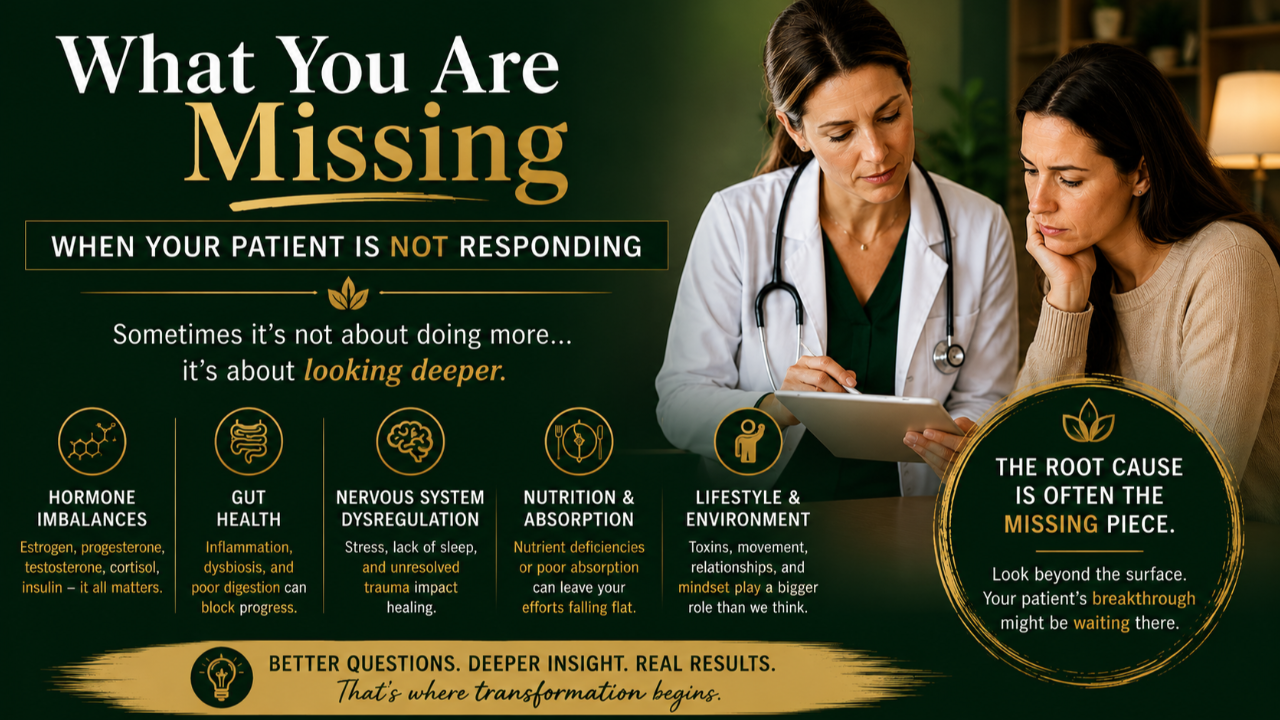
She came in with a folder. Eighteen months of labs from two different providers. Everything normal.
Michelle is 42. She has been gaining weight for two years, roughly 18 pounds, without changing how she eats. She tried cutting carbohydrates for 90 days and lost four pounds before plateauing completely. By 2 PM every afternoon her energy drops off a cliff. She wakes up around 3 AM four nights a week, lies there for 30 to 45 minutes, then falls back asleep. She wakes up exhausted.
Two providers. Eighteen months. A folder full of normal results. And she still feels terrible.
You have had this patient. Maybe more than once this week.
The Conventional Read
TSH normal. HbA1c within range. CBC unremarkable. CMP clean. By every standard metric, there is nothing to treat. The conventional visit closes with reassurance and a follow-up in three months.
Michelle leaves the visit with no new answers. She will be back.
The Systems-Based Read
A systems-based approach does not start with the lab values. It starts with the pattern.
Weight gain despite no dietary change and a failed low-carbohydrate trial. Afternoon energy crash. Early morning waking. These are not three separate symptoms to address individually. They are a pattern that points toward a specific set of upstream drivers.
When you ask what is driving this presentation rather than what is the diagnosis, the clinical picture shifts.
Her fasting insulin comes back at 16. Her HOMA-IR calculation suggests early insulin resistance, well before her HbA1c would flag anything. Her free T3 is low normal with a reverse T3 that is running higher than ideal, suggesting a conversion issue that a TSH alone would never catch. Her cortisol rhythm, when you ask about it through her symptom pattern, points toward an HPA axis that is dysregulated, which explains both the afternoon crash and the early morning waking.
None of those findings crossed a conventional threshold. Together they tell a completely coherent story about why Michelle feels the way she feels and what to do about it.
The difference was not the labs. It was the question that came before the labs.
The Gap Between Information and Application
Most NPs who are drawn to integrative medicine describe the same frustration. They have the information. They have taken the courses. They know about insulin resistance and cortisol and thyroid conversion.
What they do not have is a repeatable process for applying that knowledge in a real visit with a real patient in real time.
Without that process, every complex patient feels like starting from scratch. You are pattern-matching from memory, second-guessing yourself, spending hours researching after the visit. The information is there. The framework for using it is not.
That framework is what changes everything.
Join Me Tomorrow Night
Tomorrow, Monday May 18 at 7 p.m. MST, I am going live for a free clinical training titled "What You Are Missing When Your Patient Is Not Responding."
I am going to walk through Michelle's case in real time. Not just what I ordered. Why. And what it reveals when you read the pattern instead of the individual value.
This is for NPs who are doing everything right by conventional standards and still feel like they are missing something with their most complex patients.
Free. Live. For licensed nurse practitioners.
Register at https://www.bridgewelled.com/pl/2148775696
Cannot make it live? Register anyway and you will receive the replay.